 Brainerce Help
Order details
What each order window shows, the Order Summary, the Items panel, Manage Payment and the shipping address, and which parts you can change.
An order has four windows, each opened from a different cell on the Orders list. Opening the Summary or Items window marks the order as read for you.
| Open it from | Window | Can you change anything in it? |
|---|---|---|
| Summary column, View button | Order Summary | Internal fields, tags and tracking, and the items of an order that has not shipped (Edit items) |
| Items column badge | Order Details (items panel) | The warehouse a line ships from, and Create Refund |
| Row ⋯ menu, Manage Payment | Payment Management | No. It only shows the payment and offers Create Refund |
| Shipping column | Shipping Details | Yes, the shipping address |
The Order Summary window
The summary is the receipt for one order. The top strip shows the sales channel (its logo and name), the order status, the payment state and fulfillment state when they differ from the status, a Self Pickup tag when the customer collects the order, then the order number and the date and time it was placed.
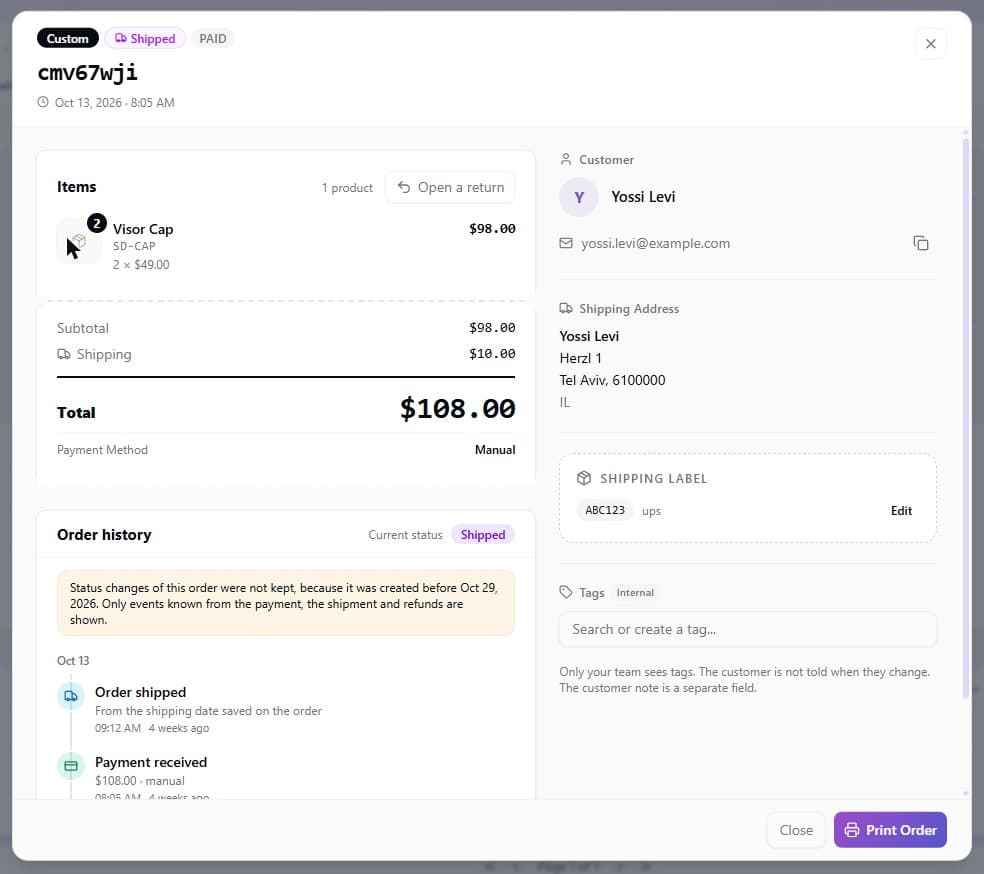
Left side, the receipt. The products (name, option choices, SKU or NO SKU, quantity, price and any line discount, and a Free tag for a free modifier option; one chip per brand sits under the SKU when the product had a brand at the sale), then the money lines. A line appears only when it applies:
| Line | Meaning |
|---|---|
| Subtotal | The products before discounts, shipping and tax. |
| Coupon | The promo code used, its title, and (x% off) or (fixed amount), with the amount taken off. |
| Discount rule lines | One line per discount rule that applied, named after the rule, with the amount it took off. |
| Discount | A discount on an order that used neither a promo code nor a rule, such as the manual discount typed on a hand-made order. |
| Other Discounts | On an order that used a promo code, any discount beyond the coupon's own amount. |
| Shipping | The shipping charged, or Free. |
| Tax or Tax (incl.) | Tax as separate lines by tax name. (incl.) means the tax was already inside the prices. |
| Total | What the order came to. |
| Gift card ····1234 and Amount charged | When a gift card paid part of the order, the last four digits of the card and the part your payment provider actually took. See the order total is not always what the customer was charged. |
| Payment Method | How the customer paid. |
| Installments | Shown as N payments when the customer paid in more than one installment. |
Right side, the people and places.
-
Customer: name, email and phone, each with a copy button.
-
Shipping Address, or Pickup Location for a store pickup order (name, address, phone and the pickup rate name).
-
Also used as the billing address appears under the shipping address when both are the same. Otherwise a separate Billing Address block follows.
-
Carrier pickup point: when the customer picked a locker or pickup point of a carrier, its name, address, hours and note. The parcel is delivered there, and the address above is the customer's own.
-
Shipping label box for orders that ship to an address. With no tracking yet it reads No label created yet and offers Create Label (a carrier app is connected; needs a role that can fulfill orders), or it reads No tracking number yet and offers Add tracking (no carrier app; needs a role that can update orders). Once there is a tracking number it shows it with the carrier, an Edit button, a Track shipment link when there is a tracking link, and a Tracking history timeline when the carrier has reported events. Create Label opens Create Shipping Label: pick one of the quoted rates (the one the customer paid for is marked Paid at checkout) and press Purchase Label; the optional Package details (weight in kg, length, width and height in cm) override the weight and size saved on the products for that label. There is no button on a Cancelled or Refunded order or a restored or imported one, and Add tracking and Edit are also hidden once the order is Delivered or Completed. See Order status and shipping and Shipping.
-
Customer Custom Fields: the answers the customer gave to your checkout custom fields, read only. A field the customer left empty shows Not set.
-
Tags: your internal labels on the order (see Tag orders). Pick a tag or type a new one and choose Create tag; each change is saved at once, with no Save button. Only your team sees tags: the customer is not told and no email is sent. The section is hidden from a team member who has no tags to read and cannot change orders.
-
Internal Fields: your order custom fields. Fill them in and press Save (it shows Saving… then Saved). Only active fields appear. A required field cannot be saved empty.
-
Customer Notes: the customer's note on the order.
-
Order history: under the totals, every status change of the order, newest first (see Order history).
The footer has Close and Print Order. Print Order prints a receipt with the customer, both addresses, products with their customizations, custom fields, the money lines (including the gift card and Amount charged lines) and the customer note.
Download all the photos a customer uploaded on an order (ZIP)
When customers upload photos into a product's buyer input fields (a photo for a mug, a canvas, a t-shirt), the Order Summary header of the Items card shows a Download photos (ZIP) button, next to Edit items. One click downloads every photo of the order in one ZIP file named <order number>_customer-photos.zip.
- It appears only when the order has two or more photos. With a single photo there is no button: click the small photo under the product line and save it from the tab that opens.
- Each file is named after what it belongs to:
<order number>_<product>_<field>, for example1042_Coffee mug_Photo.jpg. A gallery field adds a number,1042_Canvas_Gallery_2.png. When a customer used the same photo twice on an order, it is in the ZIP once. - The files are the ones the customer uploaded, with no conversion. A photo stored in original quality stays in original quality (see keep original quality for printing), and a photo stored as a regular image is the WebP of at most 2048 pixels you already see.
- A photo that cannot be downloaded is skipped, not fatal. You still get the ZIP with the others, and a message says how many were missed. Open the missing one from its thumbnail under the product line. If none can be downloaded, no ZIP is made.
- Only photos stored by Brainerce are included. A photo whose address points to another website (a storefront built to send a link instead of uploading the file) is not put in the ZIP, and it does not count toward the two photos the button needs. Open it from its thumbnail under the product line.
- The ZIP is built in your browser, so an order with very large photos can take a moment, and it needs enough free memory on your computer. It stops adding files once the archive reaches about 400 MB and says how many were left out. The button shows the progress while it works.
- It is a download of what the customer uploaded, nothing more. It does not resize, crop or print the photos, and it does not include a customer's text answers (engraving, gift message). Those stay in the Customization lines of the order.
- Photos from a customer who never ordered are not in any order. An upload that does not end up on an order is deleted after 7 days.
Order history: who changed what and when
The Order history section of the Order Summary window lists what happened to the order, newest first, grouped by day: when it was created and through which channel, every status change with who made it, the payment, refunds, the shipping label and the carrier's tracking updates.
- Custom statuses show by their own name and color. If you created statuses in Order Settings (for example Printing), the history shows that name and color, even when the order stayed under the same built-in status. Moving an order from one custom status to another is an event of its own. The line under it says the built-in status did not change.
- The history keeps the name a status had at that moment. Renaming a custom status later does not change the history. If you delete the status from Order Settings, the history still shows the name it had, with the note Status deleted from settings. The order itself falls back to its built-in status, as it always did.
- Who did it. A change made in the dashboard shows the team member's name. A change made through the API shows Through the API, and one made by Brainerce itself (a payment, a carrier update) shows The system or the provider's name.
- Orders created before 29 October 2026 have no record of their status changes. The history of such an order shows only what is known from the payment, the shipment and the refunds, and says so at the top. Brainerce does not rebuild the missing changes, and the current status is still shown correctly.
- Only your team sees the history. The customer does not see it, no email is sent when it grows, and it is not part of Print Order.
- Not in the history yet: notes, tags and the emails sent to the customer. Those changes are not recorded per order, so they do not appear here.
- Only the last 200 status changes of an order are kept.
- Returns show here too. When a customer asks to return goods from this order, or you open a return for it, each step appears in the history: requested, approved or declined, received, completed (with its refund or exchange) and cancelled, with who did it. A return that is still open is also marked on the order, so you see it before you refund or ship anything. The history only shows the steps. To work the return itself, open it from Returns (see Handle returns and exchanges). A return does not change the order's status: an order with a completed return refund shows Partially refunded (or Refunded when everything was refunded), like any refund.
Edit the items of an order: add a product, remove a line or change a quantity
Until an order ships, you can change what is in it. Open the Order Summary (the View button in the Summary column) and press Edit items in the header of the Items card. A window lists the lines of the order.
- Change a quantity with the minus and plus buttons. Setting a line to zero, or pressing Remove, takes it out, and Undo brings it back before you save.
- Add a product by searching under Add a product. Pick the variant when the product has variants.
- You never type a price. A line you keep or re-quantify keeps the price it was sold at. A product you add gets its current catalog price for the order's sales channel (the channel's own price when you set one), with no automatic discount on it. The new line also gets the product's brands from your catalog as they are now (see Brand on an order line).
- Read the totals before you save. The window shows the order total before and after, and the difference. It also checks stock: when a new quantity is not in stock it says Only N in stock and Save changes stays disabled until you lower it or restock.
- Press Save changes. The order is rewritten in one step. The timeline in Order history records the edit, with who made it and what changed.
When you cannot edit the items
The Edit items button is hidden once the order is past On hold or Paid, that is shipped, delivered, completed, cancelled or refunded, and on an order imported from another platform (it is view only). On any other order the window opens, and if the order cannot be edited it says This order cannot be edited and gives the reason. The items cannot be changed when:
- The order has shipped, or part of it has. Nothing can be added to a parcel that left, even partly.
- The order has a refund, even a partial one.
- The order has a shipping label. Cancel the label first, then edit.
- The customer was charged in another currency than the store currency, or a gift card paid part of the order.
- A bundle or a line with add-ons or customer input can only be removed. You cannot change its quantity here, and you cannot add a bundle to an existing order.
- Someone else changed the order while your window was open. The save is refused with This order was changed by someone else. Close the window, reopen the order and make the change again.
Money: an edit never charges or refunds anything
Nothing is charged, no payment link is sent to the customer by the edit itself and nothing is refunded. The edit changes the order and its stock. Moving money is always your decision. To collect a balance, see Send a payment link.
- The order was not paid yet. It simply gets the new total. The customer pays it the way they would have paid the old one.
- A paid order whose total goes up. The order becomes Partially paid and the Order Summary shows Balance due with the amount. Collect that amount yourself (cash, a bank transfer, a terminal), then press Mark balance as paid. That records only the balance, not the whole order again, and the order goes back to Paid. Brainerce does not charge the customer's card for the difference.
- A paid order whose total goes down. The order stays Paid and the Order Summary shows Refund due with the amount. Nothing is refunded automatically. Press the refund button on that banner to open the refund window with the amount filled in, then confirm it yourself. Until you do, the customer has not been repaid.
- If the order was paid in cash, by bank transfer or on a terminal. Brainerce has no payment provider to send that money back through, so the refund window cannot pay it. Pay the customer back yourself, then press Refunded by hand on the banner and confirm. That clears Refund due and adds a line to the order history. It does not send money, does not email the customer and does not create a refund record, so refund reports will not include it.
What is recalculated and what is not
- Shipping is not recalculated. The shipping charge stays as it was, even when the new items would change it. An edit never changes the shipping charge.
- Automatic discounts are not recalculated. A discount rule that applied when the order was placed stays as it was, and a product you add gets no automatic discount.
- A promo code (voucher) is treated by type. A percentage code is recalculated on the new subtotal. A fixed amount code stays the same, and is reduced when it is larger than the new subtotal. A code that no longer exists keeps its discount.
- Tax is recalculated only when the order had a calculated tax. An order that had no calculated tax (a hand-made order never has any) stays as it was. When the tax cannot be recalculated, the window says so and keeps the old tax.
- The customer is not emailed. The edit sends no message. If they should know, tell them with the order note, which is emailed (see Process an order).
- Stock moves with the edit. Units you add are held for the order and units you remove go back on sale, in the same step. If the units you add cannot be held, nothing is saved.
- The timeline records it. The edit shows in Order history as Items edited, with a line for each product added, removed or changed and the old and new total. Only your team sees it.
You need a role that can update orders. The AI assistant and the admin MCP tools can make the same edit: the assistant shows a card with the new lines and totals first, and neither moves any money.
Merge orders: combine two orders of one customer into one
When the same customer placed two or more orders that have not shipped, you can combine them into one. On the Orders list, tick the orders and press Merge orders in the bar at the bottom (see Select orders). You pick the order that stays. The items of the other orders move onto it at the price each was sold at, and the other orders are cancelled and linked to the one that stays.
Read the preview before you confirm. It lists everything the combined order does not take over, and the new total.
- Only orders of one customer, one sales channel, one currency and one kind of delivery. Between 2 and 10 orders. A merge is refused when the orders are of different customers, channels or currencies, when one is a pickup order and another is shipped (different delivery), or when one is a test order and another is a real one (a test order cannot be merged with a real one). The window names each order that does not fit and the reason.
- The order that stays must belong to a customer account. An order placed by a guest without a customer account cannot be the one that stays: the merge is refused with "has no customer account, so there is no one to match the others to". An order of a guest cannot be merged with other orders either way.
- Only orders that have not shipped. An order that shipped (even partly), has a refund, has a shipping label, is still a draft, was charged in a different currency than the store currency, was paid even in part with a gift card, contains a gift card, or was imported from another platform cannot be merged. The window names the order and the reason. An order that was paid can be merged, but only one of the orders in a merge may have been paid. Two paid orders are refused (the window says the orders "have all been paid" and that a merge takes at most one paid order), because a refund goes back through a single payment: refund or cancel one of them first. The other orders must be unpaid.
- The order that stays keeps its own shipping, coupon and automatic discounts. The shipping charge and the promo code (voucher) or discounts of the other orders are dropped. They do not carry over, so the new total can be higher than the old totals added together. A percentage promo code on the order that stays is recalculated on all the items.
- No money moves. Nothing is charged, no payment link is sent by the merge itself and nothing is refunded. The payments of the other orders are carried to the order that stays. If it now shows a Balance due, you collect it yourself and press Mark balance as paid, or send the customer a payment link. If it shows a Refund due, you pay it back and confirm it yourself (see Money: an edit never charges or refunds anything, which works the same way).
- No stock moves. The units stay held for the customer. Nothing is released and held again.
- The customer is not emailed, and no "order cancelled" email goes out for the other orders. If they should know, send them an order note, which is emailed.
- It cannot be undone. The cancelled orders stay cancelled. There is no unmerge, and Brainerce cannot split an order into two either. If you merged by mistake, create a new order by hand for what should be separate.
You need a role that can update order status and a role that can cancel orders. The AI assistant and the admin MCP tools can merge orders too: the assistant shows a card with the orders, the new total and what is dropped first, and neither moves any money.
Items panel: Ships from, downloads and customizations
Click the badge in the Items column to open Order Details. It shows the order number, the platform badge, status, date and customer name, then:
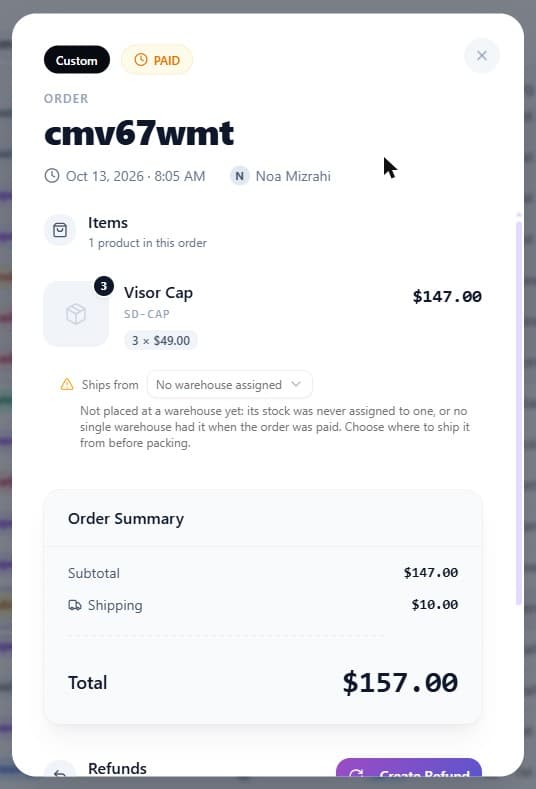
- Items: every line with its image, name, SKU, quantity and price. A product's Customization answers (text, choices, yes or no) appear under the line, or Not provided when the customer skipped one. Under the SKU, one chip per brand shows the brand the product had when it was sold, and no chip when the product had no brand (see Brand on an order line).
- Ships from: appears under each line only when your store has two or more active warehouses. It names the warehouse that line is packed from, or lists the split when one line is shared (for example "Main x2 and Outlet x1"). A line shows No warehouse assigned when no single warehouse had the stock at the moment the order was paid, with the note that you should choose where to ship it from before packing.
- To change it, open the dropdown on the line and pick another active warehouse. The stock reservation moves with it and the window shows Now ships from the new warehouse. A warehouse that cannot cover the whole line is refused, so you cannot oversell. Inactive warehouses are shown as inactive and cannot be chosen.
- You can change it only while the order still holds its stock: status Draft, Pending, Processing, On hold or Paid, and nothing shipped yet. After that the line is read only. You cannot change a bundle (kit) line, whose components ship from their own warehouses, nor a restored or imported order. Changing it needs a role that can fulfill orders.
- Downloads: for digital products, each file with its product, N/limit downloads used (or Unlimited) and the expiry date.
- Order Summary: the same money lines as the summary window.
- Refunds: Create Refund (when a refund is possible), the number of refunds issued, each refund with its amount, reason, type, tax part and Credit note number, and Refunded tax (refunds made before tax was tracked on them are not included in that total). With no refund yet it says This order has not been refunded.
- When no refund is possible, a notice says why: No payment to refund (the payment is not complete yet) or Refunds not available for the provider, with an Open dashboard button when the provider has one for manual refunds.
Brand on an order line: which brand the product had when it was sold
Each line of an order remembers the product's brands as they were at the moment of the sale. In the Order Summary window and in the Order Details window (the one opened from the Items column), one chip per brand appears under the SKU of the line. A product can have several brands, so a line can show several chips.
- A line with no brand shows no chip. If the product had no brand when it was sold, nothing is shown under the SKU.
- Old orders and imported orders have no brand chip. Orders placed before this was added show none, and neither do orders imported with the Migration Tool from WooCommerce or Shopify. Brainerce does not fill them in afterwards.
- It is a snapshot. Renaming or deleting a brand later does not change an order that already exists: the chip keeps the name the brand had at the sale.
- A deleted brand is not copied onto a new order. A brand that is only switched off (Status off) is still copied.
- Hand-made orders and edited orders get it too. An order you create by hand, an order created through the API or the admin MCP tools, and a product you add with Edit items take the product's brands from your catalog at that moment.
- It is not shown everywhere. The brand chip is not on the printed order sheet (Print Order), not in the order emails, not in a column of the Orders list and not in an export.
Brainerce does not create a page for a brand. This only shows the brand name on the order line.
The Manage Payment window
Open the order's ⋯ menu, then Manage Payment. The entry exists only for an order with a payment record, so it is missing on a hand-made order that was never marked paid, and for restored or imported orders. The window is read only apart from Create Refund.
| Field | Meaning |
|---|---|
| Payment Amount and N refunded | The amount taken and how much has been refunded so far. |
| Status badge | Paid, Pending, Authorized, Failed, Refunded, Partial Refund or Cancelled. |
| Provider, Method, Card | The payment provider, the payment method, and the card brand and last digits when known. |
| External ID and Payment ID | The provider's own reference and Brainerce's payment reference. Click the copy icon to copy either, for example to find the payment in your provider's dashboard. |
| Invoice # and View Invoice | The invoice your provider issued, when there is one. Without a download link the number shows as plain text. |
| Amount, Refunded, Remaining | The refundable balance. Remaining appears only while a refund is possible. |
| Created | When the payment was recorded. |
| Red error box | When the provider reported an error on the payment: its error code (or Error) and message. |
| Refunds | N refunds issued, each with amount, status and Credit note, or No refunds issued. |
Create Refund appears only while the payment shows Paid or Partial Refund and money remains. It opens the same window as ⋯ → Refund. See Refund an order.
The Shipping Details window
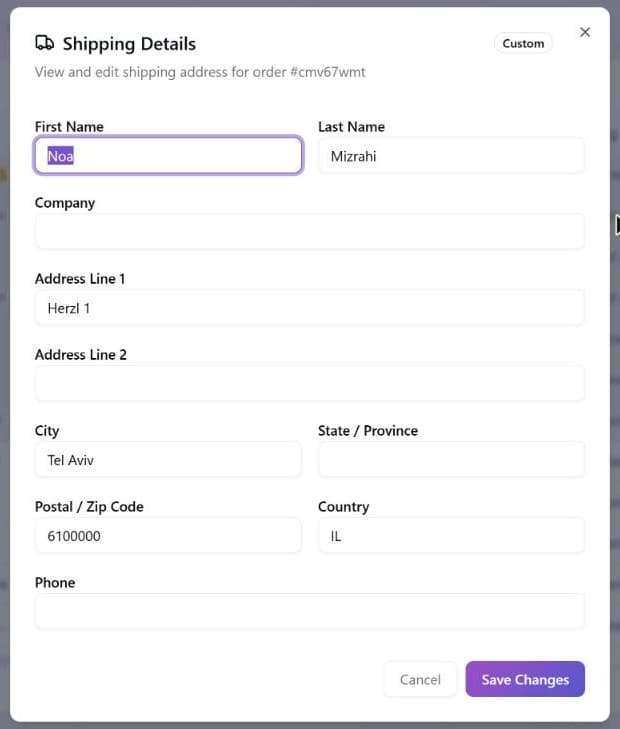
Click the Shipping cell (it shows the city and country, or Add Details). Fields: First Name, Last Name, Company, Address Line 1, Address Line 2, City, State / Province, Postal / Zip Code, Country and Phone. Address Line 1, City, Postal / Zip Code and Country are required and show Address is required, City is required, Zip Code is required and Country is required when empty. Click Save Changes.
- The change is saved on the order only. Nothing is sent to a carrier or a platform. After saving, the toast says The address on this order has been saved.
- The window is read only for orders reported by TikTok or Meta ("Read-only Platform"), and nothing can be saved on a restored or imported order.
What's next?
The Orders list
Every column, filter, row action, bulk action and search rule on the Orders page, and which cells you can edit in place.
Send a payment link
Collect the balance of an order, or ask a customer for a payment such as a deposit, with a link that opens your payment provider's secure page. What it does, when the button is missing and what it does not do.